What asbestos removal costs in Gippsland
The ranges below are published 2026 guide figures, and Melbourne figures don't carry Gippsland travel. They're a guide to help you spot a fair quote, not a price from us. Any quote comes from a licensed removalist, after they've seen the job.
All asbestos removal work is carried out by WorkSafe-licensed removalists.
Asbestos removal cost per square metre: the numbers
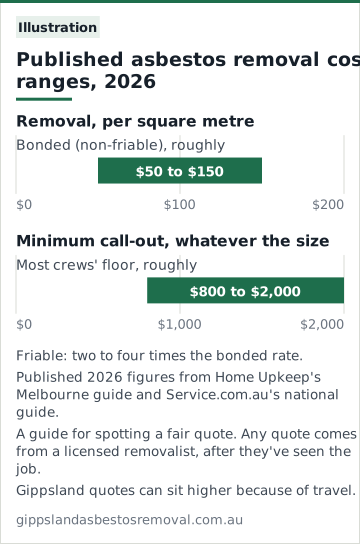
- Bonded (non-friable) asbestos: roughly $50 to $150 per square metre for removal. Painted fibro sheeting, fences, eaves, garage and shed roofs, wall linings all sit here.
- Friable asbestos: two to four times the bonded rate. Pipe lagging, loose insulation, sprayed coatings, and bonded material that has been through a fire or weathered badly and now crumbles by hand. Needs a Class A licence and a lot more containment.
- Minimum call-out: most crews have a floor of roughly $800 to $2,000 regardless of size, because the setup, the wrapping, the transport and the tip fee are the same for a small job as a medium one. In Gippsland the travel time is part of that floor.
- Disposal fee: ask whether it's inside the quote. On its own it's a few hundred dollars a load in the published 2026 guide.
- Testing: this site doesn't quote a testing price. Ring two labs for the current fee.
These are published 2026 guide figures: the square metre rate and the friable multiple are from Home Upkeep's Melbourne cost guide, and the minimum spans Home Upkeep's $800 to $1,500 and the minimum of around $2,000 in Service.com.au's national guide. Gippsland quotes can sit higher because of travel.
How much does asbestos removal cost for a fence, shed or roof?
- A fibro fence, 20 metres at 1.8 metres high: about 36 square metres of sheeting. Work it from the metre rate above, then add the minimum and travel. If the posts are sound and the sheets come off clean, it's a one-day job for two people.
- A garage or shed roof, 6 by 4 metres: about 24 square metres plus the ridge capping. Often at or just above the minimum. Access and the height of the roof move it.
- A super six house roof: the big one. A single-storey house roof is 150 to 250 square metres. Work it from the metre rate above, then add the minimum and travel; the new roof is on top. Get two quotes and make sure both include disposal and a clearance.
- Bathroom walls behind tiles: small area, awkward work, usually part of a renovation. Priced near the minimum, sometimes bundled with the builder's demolition.
What pushes a quote up or down
- Condition. Intact, painted sheets come off in one piece. Anything that crumbles by hand, including weathered or burnt sheeting that has gone that way, moves to the friable rate: two to four times the bonded rate, plus an enclosure and a Class A crew. Cracked sheet that is still hard stays at the bonded rate, and the removalist decides which it is on site.
- Height and access. A fence you can park beside is cheaper than a roof three metres up over a garden bed. A roof needs edge protection and often scaffold or an elevated work platform, hired for the days the job runs. Ask if it's in the number.
- Amount. Per-square-metre rates drop as the area rises. Two small jobs cost more than one medium one.
- Distance to the tip. Latrobe residents have Hyland Highway Landfill; Bass Coast has Grantville; Wellington has Kilmany; Baw Baw has no council facility at all. A removalist's load must go to an EPA-licensed facility, which in Gippsland can be a long drive.
- Air monitoring. Required only for Class A work indoors, or outdoors where others are at risk, by someone independent such as an occupational hygienist. On a fibro fence quote, ask why it's there; on pipe lagging inside the house, ask why it isn't.
- The clearance and the notice. Any friable job, or more than 10 square metres of bonded sheeting, needs an independent person's inspection and certificate: separate person, separate fee, sometimes rolled in. Every licensed job needs a WorkSafe notification before it starts. Both are part of why there's a minimum.
- Reinstatement. Removal quotes usually stop at "gone and clean". Putting up a new fence or roof is a separate trade and a separate quote.
How to read a quote
A fair quote says what's being removed, the area measured on site rather than guessed at from a distance, the licence class of the crew, that WorkSafe will be notified, where the waste goes with the tip fee in, whether an independent clearance is included, and what "finished" looks like: gone and clean, frame left standing, or slab swept. The four documents a licensed job produces are listed on the friable asbestos page.
To compare two quotes, line those up. Class B on one and Class A on the other means they've read the condition differently; ask both. If the cheaper quote is missing a line, add what that line costs before you decide. A quote at half the other is usually not for the same job, or the crew isn't licensed for the material.
Why the published figures disagree by three times
Search the price and the numbers don't agree. Here's the gap.
- A list price is the starting rate for the easiest job there is. Ground level, intact sheets, a short drive to the tip.
- The directory figures are finished invoices. Setup, wrapping, notification, tip fee and the drive are in them, which is why they sit higher.
- Per metre of what? A fence is often priced per running metre, sheeting per square metre, so the two figures look nothing alike and can be the same money.
- Melbourne figures don't carry Gippsland travel, and some ranges quietly leave out disposal, the clearance and access gear.
A number below the ranges on this page from someone who hasn't seen the job is a starting rate, not a quote.
Asbestos removal price, in one line
The honest asbestos removal price for a Gippsland job is a licensed removalist's written quote after seeing the photos or the site, and nothing on this page replaces it. The guide figures above are published 2026 figures, and Gippsland travel, tip distance and access move them either way. If you're new to all this, start with the overview of asbestos removal in Gippsland.
Questions people ask about this
Is it cheaper to do it myself?
For a small, intact, bonded piece, it can be, if you do the wetting, wrapping, labelling and the trip to the tip properly. Past a few sheets the time, the gear and the tip rules eat the saving, and the state's advice is to use a licensed removalist. See can I remove it myself.
Does the price include disposal?
Usually, but confirm it. Ask where the waste is going and whether the tip fee is in the number.
Do I need a clearance certificate?
A clearance certificate from an independent person is required before the area is reoccupied when the job involved any friable asbestos or more than 10 square metres of bonded sheeting. Smaller bonded jobs don't require one; ask for a written clearance anyway if you're selling or a builder follows.
Does the council or the government help with the cost?
Only one thing we found: a removal kit for Latrobe City residents, on the disposal page. After a major storm or fire, the Insurance Council of Australia notes that councils sometimes waive tip fees. For an ordinary removal job there's no subsidy we could find.
Why did the price go up after they came out?
Usually condition. Sheets that looked fine from the road turn out chalky, cracked or hail-pocked up close, and weathered sheeting that crumbles is handled and priced as friable. Or the area was bigger than the phone estimate. A price given without seeing the job is a guess.
Sources checked: October 2026
Where these facts come from
- Occupational Health and Safety Regulations 2017 (Vic)
- asbestos.vic.gov.au: Safe removal steps
- Latrobe City Council: Asbestos and fibreglass insulation disposal
- Baw Baw Shire Council: Transfer stations and illegal dumping
Price ranges from published guides
Call, or send photos.
Your job and photos stay on file with us.
The guides cover cost, tip rules and the DIY rules.