Asbestos eaves, walls, ceilings and bathrooms
This is the asbestos that turns up mid-renovation: behind the tiles, above the kitchen ceiling, under the eaves. The rule is the same as outside. Under 10 square metres and intact, you have options. Over that, or damaged, a licensed removalist takes it out before the builder goes further.
All asbestos removal work is carried out by WorkSafe-licensed removalists.
Asbestos eaves, asbestos bathroom walls and asbestos ceilings: where it hides in a Gippsland house
- Bathroom and laundry walls. Compressed asbestos cement sheet behind tiles, or plain fibro on the lower half of the wall. Almost universal in wet areas built before 1990.
- Eaves and soffits. Flat fibro sheets under the roof overhang, often painted a dozen times. The most common asbestos on a brick veneer house.
- Ceilings and internal walls. Fibro linings in sleepouts, extensions, garages converted to rooms, and some whole fibro houses.
- Vinyl floors. The tile itself or the black backing on sheet vinyl. Comes up as friable dust if scraped.
- Kitchen splashbacks and behind the stove. Compressed sheet used as a heat shield.
- Heater flues, hot water pipe lagging, old fuse boards. The friable ones. See friable asbestos.
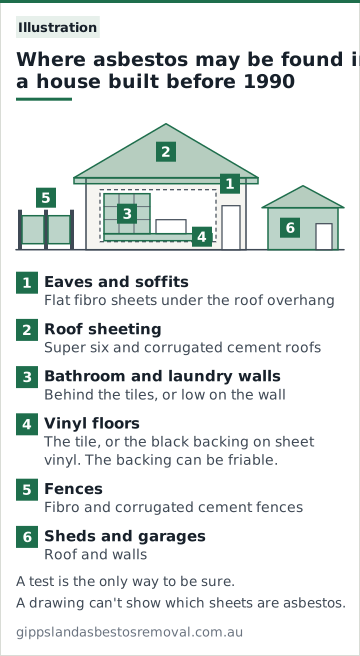
How it fits into a renovation
The order matters. Test first, before the demolition quote. If the sample comes back positive, the licensed removalist does the strip-out of the asbestos parts, clears the room, and then the builder or plumber carries on. Tell the builder the sequence up front so they can plan to pause until the room is cleared. The WorkSafe notice is 24 hours for a small bonded job and five days for anything bigger or friable, so a test in week one and removal in week two keeps the job moving.
If the sheets are intact and you're not touching them, the state's homeowner guidance is still that removal is the goal; while you wait, its steps reduce the risk but don't stop the material degrading, starting with don't disturb it. Ask a licensed removalist or hygienist about the wall in question; tiling or lining over it leaves the asbestos in place and the next owner inherits it. It isn't for a floor you're sanding or a wall you're cutting a window into.
What the removal involves
Wet areas are small, so the cost is driven by the awkwardness rather than the square metres. The crew seals the room, runs negative air where the material is friable, wets and removes sheets whole where possible, bags fragments, and wipes every surface down. Vinyl floor backing that has to be scraped is Class A work. A bathroom or eaves job is often under 10 square metres of bonded sheeting, which needs no clearance certificate; anything friable, or over 10 square metres, gets a clearance certificate from an independent person before the builder starts. Ask for a written clearance either way.
What a wet-area job runs to
Most bathroom, laundry and eaves jobs land at or near the minimum call-out of roughly $800 to $2,000, because the area is small and the setup is the cost. A whole-house eaves job on a large brick veneer is a bigger number. If the builder is already doing demolition, ask whether their removalist can bundle it; the notification and setup are then shared. See the cost guide.
Fibro or plasterboard: telling them apart before you drill
Plasterboard has a paper face and a soft white core. Asbestos cement sheet is hard, thin and grey right through, and the joins are usually covered with a timber batten or a cement strip rather than taped and set flush. Don't screw into, cut or tap a sheet to find out which you have: that disturbance is exactly what the rules are written around. The dimpled surface on some eaves sheets, the golf-ball pattern, is a clue, not proof. Age is the strongest cue: wet-area linings, eaves and internal fibro in a house built or lined before 1990 are asbestos until a laboratory says otherwise. See testing and inspection.
A bathroom strip-out, in order
- The plumber isolates the water and pulls the fixtures the day before.
- The doorway is sealed with plastic and signed. The rest of the house stays in use, with the ducted heating or cooling switched off. Anything friable goes under negative pressure.
- Tiles bonded to the sheet come out with the sheet, wet, in panels. Chipping tiles off an asbestos wall is what puts fibres in the air.
- Plain linings are unscrewed or levered off whole and wrapped in the room. Vinyl floor backing is Class A work.
- Studs and floor are wiped with damp rags and vacuumed with an H-class vacuum. No brooms.
- A whole bathroom's walls are usually over 10 square metres, so an independent person issues a clearance certificate before the builder returns. One small panel may be under the line; ask for a written statement of what was removed anyway.
- The room is left at bare frame. Relining, waterproofing and tiling are the builder's job.
Questions people ask about this
The tiler says he'll just tile over it. Is that okay?
The state's homeowner guidance is that removal is the goal; while it waits, don't disturb it, and those steps reduce the risk without stopping the material degrading. Drilling for towel rails and taps into it is exactly that disturbance. Get the sheet tested, ask a licensed removalist or hygienist before the tiler starts, and tell every trade what it is.
We found it after the builder started. What now?
Stop work in that room, don't sweep, and get a test and a licensed quote before anyone goes back in. Work resumes once the material is out and cleared.
Is the dust in my ceiling asbestos?
Not usually; ceiling dust is mostly dirt and old insulation. Loose-fill asbestos insulation does exist in a small number of Australian houses. If you're in doubt, a sample test settles it.
Could my roof eave be made out of asbestos?
On a house built before 1990, very likely. Flat fibro eaves are the most common asbestos on a Gippsland brick veneer. EPA Victoria's guidance is that bonded asbestos cement in good condition is a very low risk. Don't sand, pressure wash or paint them, and test before anyone replaces them.
I'm ripping up vinyl to uncover the floorboards. The furry backing is the worry, right?
Yes. The vinyl itself is bonded; the paper or felt backing under old sheet vinyl is the friable part, and scraping it is Class A work. If the vinyl is intact, ask whoever you engage whether it can stay where it is. If it has to come up, stop at the first sight of backing and get it tested.
Can the sparky cut in a new power point in an asbestos wall?
Cutting is the disturbance the rules are written around, and many electricians will refuse to cut fibro until it's tested. Ask yours. If the wall is positive, a licensed removalist cuts the penetration and the sparky fits the point.
Sources checked: October 2026
Where these facts come from
- Occupational Health and Safety Regulations 2017 (Vic)
- WorkSafe Victoria: Asbestos removal notification
- asbestos.vic.gov.au: What if I can't remove it now?
- Asbestos and Silica Safety and Eradication Agency: Householders and home renovators
- EPA Victoria: Asbestos waste
Price ranges from published guides
Call, or send photos.
Your job and photos stay on file with us.
The guides cover cost, tip rules and the DIY rules.