Storm and fire damaged asbestos in Gippsland
Gippsland gets the weather. A fibro fence flattened by a wind change, a shed roof peeled back, a house lost to bushfire. Sheeting that is burnt and now crumbles by hand is friable, and the state's advice is that friable asbestos should only be removed by a licensed removalist. Here's what to do in the first hour and what happens after.
All asbestos removal work is carried out by WorkSafe-licensed removalists.
Storm damaged asbestos: the first hour
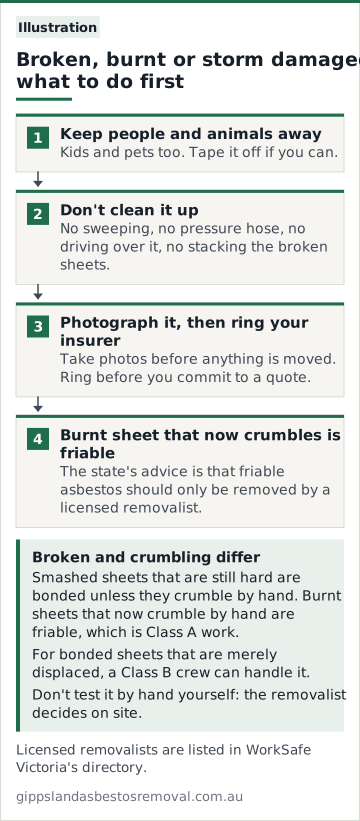
- Keep people, kids and animals away from the debris. Tape it off if you can.
- Don't sweep, don't hose at pressure, don't drive over it, and don't stack the broken sheets. Water from a gentle spray to keep dust down is fine.
- Photograph everything for the insurer before anything is moved.
- If sheets have landed on a neighbour's side or the footpath, tell them and the council.
- If the material is broken, burnt or storm-damaged and you need someone today, WorkSafe Victoria's directory lists licensed removalists who can help straight away. Find one. For bonded sheets that are merely displaced, a Class B crew can handle it. Sheets that are burnt and now crumbling by hand are friable, which is Class A work. Smashed sheets that are still hard are bonded unless they crumble by hand. Don't test it by hand yourself: the removalist decides on site.
The emergency notification
Normally a licensed removalist notifies WorkSafe before starting: five days ahead for friable material or more than 10 square metres of bonded sheeting, 24 hours ahead for a smaller bonded job. The regulations also allow notification within 24 hours of starting, but only where the work results from an unexpected situation as regulation 299 defines it. Ask which notice period they're working to, so the paperwork matches the job and nobody is relying on an exception that doesn't apply.
Insurance
Whether storm damage and the asbestos clean-up are covered, and whether the clean-up is paid above the sum insured or out of it, depends on your policy; the Insurance Council treats debris removal as policy-dependent. The insurer will want photos, the removalist's quote and, afterwards, the clearance. Get the quote in writing with the licence class and the disposal included. If the insurer wants to appoint their own removalist, that's normal; check the licence class matches the damage.
Asbestos after a fire
A fibro house or shed that has burnt is the hardest asbestos job there is. Sheeting that now crumbles by hand is friable, the ground is often contaminated, and the site is usually wet from firefighting. A removalist decides the class on site; where it's friable, the clean-up runs as Class A work: containment where possible, wetting, careful removal of debris, removal of the top layer of soil where testing shows it's needed, and a clearance certificate from an independent person before rebuilding starts. After large fires the state has sometimes run coordinated clean-up programs; for a single property it's a private removalist and the insurer. Don't start clearing it, and don't put a bobcat through it, before a Class A crew has looked.
What the unexpected-situation rule actually says
Regulation 299 is narrower than people assume. It covers a sudden, unexpected event, including a non-routine equipment failure, that may result in people being exposed to airborne asbestos fibres; and an unexpected breakdown of an essential service such as gas, water, sewerage or electricity that needs immediate repair. In either case the removalist may start and lodge the written notice not later than 24 hours after commencing. That's the whole exception.
Where the official fire guidance lives
WorkSafe Victoria publishes a bushfire recovery page on asbestos clean-up at worksafe.vic.gov.au/bushfire-recovery-asbestos-clean. Read that first. A fire site runs under the same rules as this page: burnt sheeting that now crumbles is friable, the clean-up is Class A work, and the four documents it produces are listed on the friable asbestos page.
Three questions for the insurer
The Insurance Council of Australia's disaster guidance is blunt: debris removal after a total loss can be very expensive where contaminants such as asbestos are present, and policies differ. Some allow debris removal above the sum insured; others deduct it from the sum insured. No official source says asbestos removal is covered as a matter of course, so ask, in writing.
- Is debris and asbestos removal paid on top of the sum insured, or out of it?
- Will the insurer appoint the removalist, and which licence class do they hold?
- Are "make safe" works separate? The Council describes make-safe as immediate work to stop further damage, such as tarps and treating debris with an adhesive. That isn't removal.
After a major event, ask whether the council has waived tip fees; the state sometimes covers part of debris removal too.
What fire does to the sheet
Asbestos after fire is the one situation where the state's advice is blunt: stay out, keep others out, and get a licensed removalist and your insurer involved before anyone touches the site. Burnt fibro is brittle and the ash carries fibres, so the wetting, wrapping and clearance steps matter more, not less.
Questions people ask about this
A sheet blew off the fence but didn't break. Is that urgent?
Less so. Leave it where it lies, keep people and pets off it, don't carry it anywhere, and get a licensed removalist in the normal way. It still counts against the 10 square metre DIY limit with the rest of the fence.
Can the SES remove it?
The SES makes the site safe; they don't remove asbestos. They may tarp or cordon it. Removal is a licensed job.
What does emergency removal cost?
Storm-displaced bonded sheets are priced like normal removal with a callout. Burnt material that now crumbles is priced as friable, plus soil and clearance. Whether your policy covers it depends on the policy; ring the insurer before you commit to a quote.
Our shed roof blew off in the storm. Can I pick the bits up?
Leave them where they are; stacking breaks more. Damp them down gently, keep people and animals off, and photograph them for the insurer. That's urgent: if the material is broken, burnt or storm-damaged and you need someone today, WorkSafe Victoria's directory of licensed removalists can help straight away. Once a removalist takes the job, they decide whether the notice can be lodged after starting.
Can I hose the debris down and put it in a skip?
No on both counts. A pressure hose lifts fibres, and a skip isn't a licensed facility; the tip will refuse the load. A gentle spray to hold the dust, then leave it for whoever you engage to wrap and take to an EPA-licensed site; this is urgent too, so ring a licensed removalist from WorkSafe Victoria's directory directly, who may be able to come out today.
The storm took the fence out and I can't reach the neighbour. Can I go ahead?
Where a dividing fence has been damaged or destroyed, the work is urgent and notice isn't practical, the Fences Act lets you do urgent fencing works first; its own examples are a falling tree, fire or flood. The asbestos side needs the same urgent response: call a licensed removalist from WorkSafe Victoria's directory today. Removal of a dividing fence counts as fencing works under the Act, but no official source confirms the contribution covers licensed asbestos removal; if it's argued, the Dispute Settlement Centre of Victoria is the place. Photograph it, get the quote in writing once you've engaged someone, tell the neighbour as soon as you can, and serve an urgent-works notice afterwards.
Sources checked: October 2026
Where these facts come from
- Occupational Health and Safety Regulations 2017 (Vic)
- WorkSafe Victoria: Asbestos removal notification
- WorkSafe Victoria: Asbestos removal licence application
- asbestos.vic.gov.au: How to identify asbestos safely
- Fences Act 1968 (Vic)
Pages mentioned here
Call, or send photos.
Your job and photos stay on file with us.
The guides cover cost, tip rules and the DIY rules.